by 007hertzrumble | Apr 17, 2015 | Octopussy
Octopussy: A Sweet Distraction for an Hour or Two
by Adam Slusar (@TapwaterAlice)
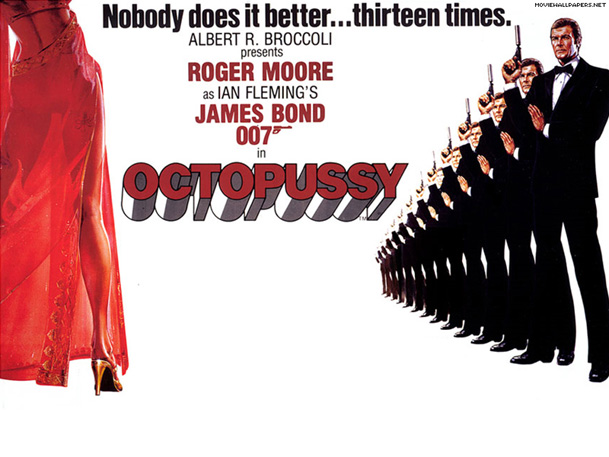
Frequently lambasted for its cartoonish excesses, perplexing storyline and – of course – being the only James Bond film to see Roger Moore disguise himself as a clown, Octopussy is generally considered to be one of the weakest entries in the 007 franchise. Like Moonraker, the humor falls flat at times; look no further than one scene in which a Tarzan cry accompanies Bond as he swings across treetop vines. Ten years after his initial turn in Live and Let Die, Moore was ostensibly “too old” to play Bond any longer. And with the revered Sean Connery set to return as 007 in Never Say Never Again that same year, Octopussy was thrown into a “Battle of the Bonds.” The odds seemed stacked against it; film critics already knew which James Bond they preferred, and needless to say, it wasn’t Roger Moore.
But while Octopussy may falter due to its occasional missteps and oddities, it’s actually pretty great. A charming, elegant, and inventive action thriller, Octopussy is superior to Never Say Never Again in almost every way, and is by far the most unfairly maligned of the James Bond films.
While the previous effort, For Your Eyes Only, was a departure from the campier Bonds of the 1970’s, Octopussy retains a comfortable balance between fanciful escapism and Fleming-esque adventure. Richard Maibaum and Michael G. Wilson, in collaboration with George MacDonald Fraser, wrote a film that fits Roger Moore like a glove; combining his penchant for casual wit with his occasional ruthlessness (as evidenced by his car-kicking performance in For Your Eyes Only). We get to see Moore deal a few bullets in addition to his fair share of one-liners.
Even with age, Moore still proves perfectly capable of selling his unique brand of 007 in Octopussy, lending a sense of credibility without betraying the overall tone of the film. His performance acts as a nice counterpoint to his passive-aggressive portrayal in Moonraker. Although the vehemently detested “clown scene” is remembered for all the wrong reasons, it demonstrates Moore in an authentic, all-too-rare occurrence of Bond losing his cool as a doomsday machine counts down to its final seconds; much like The Spy Who Loved Me or For Your Eyes Only, this showcases Moore at his absolute finest.
In terms of progressive feminism and gender equality, Octopussy is a considerable milestone in a franchise made popular by its womanizing secret agent protagonist. Leading the charge – and an army of jumpsuit-wearing female acrobats – is Octopussy herself, a neutral entity working alongside the nefarious Kamal Khan (Louis Jourdan) in a grand-scale jewel smuggling plot. Previously seen as Andrea Anders in The Man with the Golden Gun, Maud Adams lends an air of mystery, assertiveness, and professionalism to role of Octopussy. Odd though it may be for a suggestively-named Bond girl to live on an island inhabited only by women while also running a travelling circus, these sort of extravagancies are part-and-parcel with the 007 franchise, and Octopussy exemplifies the standard of proactive female characters in the Bond films.
Octopussy marks the first (but not the last) Bond film to divide its screen-time between two main villains. In addition to Kamal Khan, we have General Orlov (Steven Berkhoff), the true mastermind behind the theft of a Fabergé egg and an evil plot to overtake Western Europe with a Russian artillery brigade. This is a brilliant plot perpetrated by two sub-standard villains, but Jourdan and Berkhoff do admirably with their otherwise thinly-written roles; Khan is given juicy dialogue to complement his incredibly suave demeanour, while Orlov chews up every scene with intense proclamations.
Filling in for Oddjob and Jaws this time around is the blunderbuss-wielding Gobinda, who gets to take on Bond in some of the most inspired stunt sequences in the film. In a nutshell, the villains of Octopussy leave something to be desired, but are still more colorful and entertaining than your average Blofeld regurgitation.
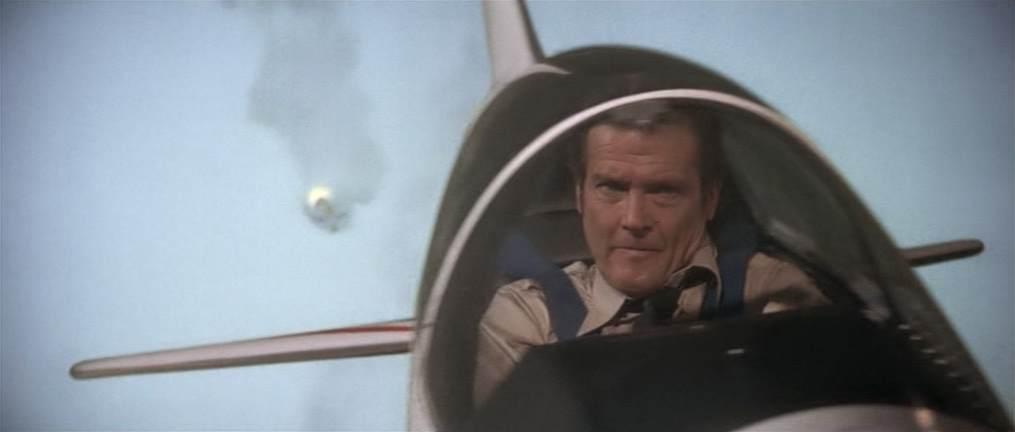
Clearly inspired by the high-adventure of Raiders of the Lost Ark two years prior, Octopussy contains no shortage of tremendous action scenes. This time around, we get to see Bond pilot a mini-jet while pursued by heat seeking missiles, taking on a thug with a razorblade yo-yo, leaping across train cars while evading dangerous obstacles, and even clinging for his life from the top of an airborne plane. Here, director John Glen demonstrates his strengths as an action director. He would continue to up the ante in his three subsequent efforts. Octopussy, nonetheless, contains some of the finest stunt choreography in the Bond series.
Following the post-disco instrumentals of Bill Conti in For Your Eyes Only (of which I’m admittedly a fan), John Barry returns to the Bond franchise with Octopussy, lending gravitas to the film with a sweeping, romantic score occasionally punctuated by frenetic action cues and exotic flair. His work in Octopussy would pave the way for his return in A View to a Kill and The Living Daylights, and Barry would provide those films with perhaps his greatest work.
If you aren’t a fan of the Roger Moore films leading up to it, then Octopussy may not be your cup of tea. Still, it isn’t the train-wreck that most people would have you believe. I first watched Octopussy late in the game, expecting something utterly terrible but coming away pleasantly surprised but also a little disturbed that so many people failed to see the pure joy of Bond escapism contained within. All the negativity surrounding Octopussy chalks up to needless comparisons to the Connery era and an unusual emphasis on the sillier aspects of the film. And truth be told, it is silly, but there’s just so much more to it.
First Bond Movie: Tomorrow Never Dies
Favorite Bond Actor: Roger Moore
Favorite Bond Girl: Solitaire
How I Discovered #Bond_age_: Nic Suszczyk of The GoldenEye Dossier, who invited me to participate in the Moonraker Live Tweet Session.
by 007hertzrumble | Apr 17, 2015 | For Your Eyes Only
For Your Eyes Only: Senescence in FYEO
By Krissy Myers (@krissy_myers)

After the extravagant and financially successful but critically panned release of 1979’s Moonraker, the creative team at EON Productions decided to take James Bond back to basics. With John Glen, a new director at the helm, 007 boldly entered the 1980’s with the straightforward spy thriller For Your Eyes Only. No more Jaws, Bondulas, outer space laser tag, implied space orgies or explicit attempts at re-entry by our lecherous but loveable Bond, Roger Moore.

“How could I bite off such a lovely face?”
Aside from a few throwaway moments, For Your Eyes Only succeeded in doing exactly what it set out to do. It was well received by critics at the time and is generally viewed as proof by Bond fans that Moore could be a serious spy when the opportunity was presented. This is how most reviews and essays praise this particular Bond film, and I’m in agreement. I’m not certain, however, that my particular reasoning behind this belief has ever been addressed in a demonstrably positive light. On the contrary, my feelings are rooted in the most ubiquitous criticism about the latter Roger Moore era.
First, a look at the opening scene.
After the gun barrel sequence, a graveyard becomes the very first shot of For Your Eyes Only. A man walks in the distance. He approaches a grave with a bouquet of red roses.

Teresa Bond, beloved wife of James Bond? She who died in 1969? James Bond’s face hasn’t yet been revealed and already we have the first overt reference to the events concluding On Her Majesty’s Secret Service presented in the Bond series to date. FYEO: not messing around! Let’s have a look at the Bond reveal, shall we?
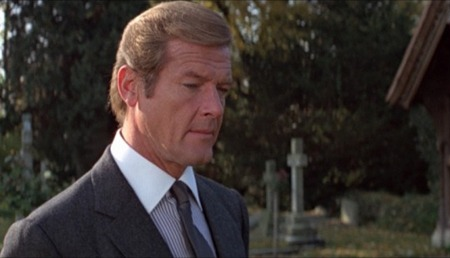
Bond looks more distinguished. Mature even. If you were a REAL detractor, you would probably say something along the lines of “Roger Moore is too old to play James Bond now.” To my beloved Moore detractors, I ask you but one question:
How old is James Bond, anyway?
Unfortunately, there isn’t a clear-cut answer to this question in the novels let alone the films. Without going into too much detail, the Literary Bond was born on or around the 11th of November in either 1920, 1921 or 1924. Others have suggested that the birth of Movie Bond remained November 11th, but later, in 1930, to match Connery’s year of birth. Without making too forceful an assertion, 1930 seems to be an appropriate choice. Not to mention, if you were to add each Bond’s respective years of birth (Lazenby being born in 1939 and Moore in 1927) and derive the average, you would get 1932. It’s safe assume then that in Dr. No James Bond was in his early to mid thirties.
With the first reference to Tracy Bond since her death, her tombstone heavily implies that the James Bond in On Her Majesty’s Secret Service is the very same Bond in For Your Eyes Only. On top of that, it’s suggested in OHMSS that this Bond was the same Bond in Dr. No and beyond when Bond was seen going through his desk. The hard date on Tracy’s tombstone along with the desk scene, indicates that James Bond was the same man in every film and series continuity up until this point occurs in real time. If we can suspend our disbelief just slightly in regards to George Lazenby’s portrayal of Bond in OHMSS and consider Sean Connery’s return to the role in 1971’s Diamonds Are Forever and if James Bond was 30-35 years old in 1962 and the Bond films happen in real time, then in 1981 James Bond would have been between the ages of 49 and 54 years of age. As I mentioned before, Roger Moore was born in 1927, which would have put him at the age of 53 at the time of FYEO’s release.

Okay, so you’re technically the right age to play Bond. Why do you have to be so smug about it?
Honestly, I have absolutely no idea whether or not that this was on purpose, but if a creative team chooses to start a film with a widowed, visibly older James Bond in a graveyard, laying flowers on the grave of his wife who passed away 12 years ago, it’s not too farfetched to assume that a motif was fermenting there: James Bond, the character and the franchise, was starting to get old. In FYEO, senescence, beyond the pre-credit sequence, isn’t something that’s explicitly explored or touched upon through the film in a superficial, “I’m getting to old for this business,” manor. That would be too jarring for an audience keen on a more youthful, exuberant portrayal of the character. Bond still scuba dives, drives cars with reckless abandon and scales steep cliffs. The notion of an aging Bond is explored in the three distinct relationships that he has with women throughout the film.
Bibi Dahl

“I said get off of me. Not get off on me.”
The one character that comes the closest to a Bond-is-getting-old joke is the precocious teenage figure skater Bibi Dahl. She seems less focused on winning Olympic Gold and more interested in seducing a much older 007. Although slightly older than her character, actress Lynn-Holly Johnson bares a resemblance to Lolita‘s Sue Lyon in physical appearance and demeanor. In an act, beyond attraction to Bond, but perhaps as self evidence of her own perceived maturity, Bibi sneaks into his room and slips under the overs of his bed, nude, upon him entering his suite. Bond made the obvious wise choice in not allowing himself to be seduced, but didn’t ignore her advances either. With the suggestion of buying an ice cream, Bond the Lothario became Bond the chaperone.
As irritating Bibi becomes, it displays Bond’s maturity as well as Moore’s penchant for chivalry (as mentioned in my previous My Favorite #Bond_age_ essay for The Spy Who Loved Me), considering the young lady’s needs and desires. Despite Bond, well, being Bond, he understood that Bibi probably was just looking for attention from someone older. That’s something many teens, my teenage self included, do for a variety of reasons. Rather than take advantage or ignore her totally, Bond indulges her in a non-threatening way, if only somewhat begrudgingly. It was a very paternal gesture on Bond’s part, which would have probably played out differently had Bond been younger.
Countess Lisl von Schlaf

“Side boob? I’ll give you more than side boob.”
The scenes between Bond and Countess Lisl von Schalf serve as the most typical 007 relationship in FYEO. The perceived villain sent his mistress, Lisl, to seduce and extract information from James. It wasn’t a great deviation from previous Bond films aside from Lisl being a more mature woman. The “nightie” exchange conveys a tinge of nostalgia and a common origin shared between her and Bond.
“Oh, my nightie almost slipped!”
“So did your accent. Let me guess, Manchester?”
“Almost. Liverpool.”
Both were older, from the same country and took an instant liking to each other: each a respective beacon of familiarity among the exotic locals and pretty young things in the movie. The Countess is a breath of fresh air for Bond and the pacing and tone of the film, at least initially. An easy going, assured, mature lady who stays up at night and has champagne and oysters sitting in her fridge, making it all too easy for Moore’s Bond to do what he does best: be a magnificently smooth bastard. Not to mention, Bond has always been fond of falling into an obvious trap. No wonder he seemed so despondent when he found Lisl dead on the beach. His scenes with Lisl were really the only part in the film up that point where he got to have any fun.
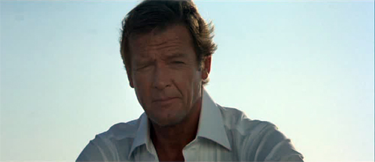
“Goodbye, Countess.” Aww, Sad Bond is sad.
One character in particular probably wasn’t entirely sad when the poor Countess met her untimely end.
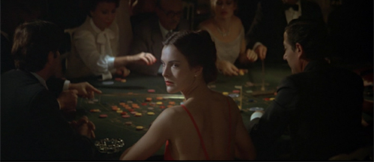
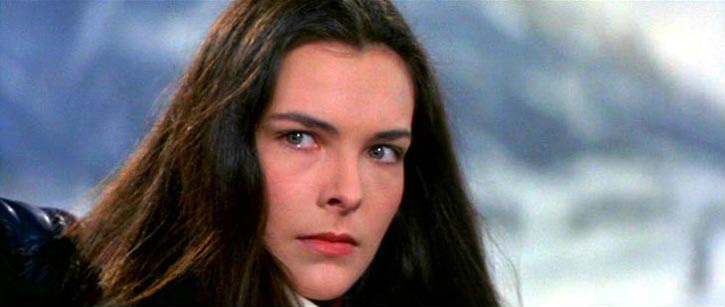
The above is a shot of Melina at the casino, watching Bond leave with Countless Lisl. She wasn’t too thrilled about it.
Melina seems to be a sort of middle ground between Bibi and The Countess in age and in terms of how she interacts with Bond. Their relationship begins as mostly platonic and remains that way for the majority of FYEO, but by the end, they engage in one of the more beloved Bond tropes: making whoopee on a boat. Something about this particular Bond film, which presses on my mind, is this: why did Melina and James suddenly end up getting romantically involved at the end of FYEO? Was it merely because it was a prerequisite for a Bond’s Belle Du Jour to have sex with 007 at some point during the film or was there a deeper reason for it?
The other and much more prevalent motif in FYEO is revenge; avenging Tracy’s death in the pre-credit sequence against not-Blofeld and the driving force behind Melina’s character in getting revenge for the death of her mother and father. Melina and Bond initially cross paths because Melina’s father was contracted by MI6 to retrieve the ATAC machine (the movie’s McGuffin) before the Russians. After a few close calls and an unglamorous car chase with the Citroen 2CV, Bond and Havelock… wax poetic on the nature of revenge?
“The Chinese have a saying: Before setting off on revenge, you first dig two graves.”
“I don’t expect you to understand, you’re English, but I’m half Greek and Greek women like Electra always avenge their loved ones.”
Certainly Bond was very knowledgeable about revenge. He was more than willing to share such knowledge with Melina, but not anything, which may be concealed in his pants. They meet several times throughout the film and rather than Moore taking Havelock back to his room for some sexy time, he advices Melina to essentially, stay out of harm’s way. Moore’s chivalrous, paternal instincts rear their head once more.
Melina’s mention of Electra was interesting as well. Sure, she was of Greek origin and it was an apt comparison, but in my observations, any mention of Electra in this sort of context tends to be shorthand for Daddy Issues in modern popular culture.
A capable, mature-for-her-age woman becomes fixated on an older, even more capable, sophisticated man due to deep-rooted issues, usually involved with death or abandonment, with their Father. It’s an old trope that fits neatly in FYEO. Melina was a capable, mature-for-her-age woman avenging the death of her Father; and Bond was an older, capable and sophisticated man. Moore’s Bond especially fits that description. It was a deep and radical prospect for Melina (and I suppose to an extent Bibi as well), to be sexually attracted to James for reasons beyond him being a sexy, vigorous man’s man. I think that the creatives on this film realized that this was a little more difficult to pull off with an aging Roger Moore. With Bibi it was played for laughs, but with Melina it was a little subtler – just dim enough for audiences not to notice right away.
The screen shot I used to show Melina’s disapproval of Bond leaving with Countless Lisl makes a bit more sense now, doesn’t it? Bond played adviser to her throughout the film and for reasons I cited previously, it was not too much of a stretch for her to become attached to him. To have had someone like Bond so readily fill that gap at a point where she was psychologically compromised with avenging her parent’s death, it wasn’t especially unusual for them to finally hook up at the end once Kristatos was finally killed by Colombo. There was even a nifty deleted scene where James returns to Melina’s boat and she brings up his rendezvous with the Countess (which can be viewed here at the 2:15 mark if you don’t own the BluRay: http://www.youtube.com/watch?v=z1c-Q0-w76Y)
“I called your hotel. You weren’t there.”
“Didn’t get back there last night.”
“I’m not interested in your sex life, Mr. Bond.”
“My sex life is not what I came here to discuss.”
Oh yeah, she went there. Bond wasn’t pursuing Melina. Melina was pursuing Bond. While she succeeds, it’s still extremely interesting that Bond went for only the most mature, sophisticated lady right away. That was a definite hallmark of his age.
Ultimately what I’ve been trying to express is this:
Not only did Roger Moore’s Bond work because he was older, but his age lends gravitas and complexity to the role.
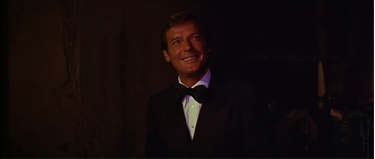
“Thank you, Krissy.” You’re welcome, Roger.
He was too busy, too focused and too old to lightly fool around with pretty young things. Bond simply wanted to get the job done. This cooler, but still sympathetic, witty and chivalrous portrayal served as the one moment in his tenure where Moore managed to strike a balance between Ian Fleming’s pensive and melancholy Bond of the novels and his own personal interpretation. Roger may have found himself in the role in The Spy Who Loved Me, but it was in For Your Eyes Only where he truly mastered the character and successfully took Bond to a place where he’d never been before: over the hill. I understand why that might make some Bond fans feel a bit uncomfortable, but maybe the reason contemporary Moore detractors cite his advancing age as a flaw is routed in personal tastes and beliefs. I feel that this criticism is a bit shallow and does a disservice to Bond’s credibility as a character. It’s the only reason I can think of that Bond fans have the audacity to dictate that Bond cannot be a convincing and compelling sexy super spy because of his age. James Bond is more than a serial womanizer, cheap thrill and license to kill. Roger Moore and For Your Eyes Only went above and beyond in proving that.
First Bond Movie: Thunderball.
Favorite Bond Actor: HAH!
Favorite Bond Girl: Teresa Di’Vicenzo from On Her Majesty’s Secret Service. Guilty pleasure goes to Pam Bouvier from Licence To Kill.
How I Discovered #Bond_age_: Through the James Bond tag on Tumblr.
First #Bond_age_ Live Tweet: Strangely enough, The Spy Who Loved Me. How appropriate!


